Positioning of the patient
Author: Dr. med. Gesche Riabowol (geb. Tallen), English Translation: Dr. med. Gesche Riabowol (geb. Tallen), Last modification: 2026/01/12 https://kinderkrebsinfo.de/doi/e211428
Table of contents
To ensure that healthy organs located in the vicinity of the tumour are exposed to as low radiation as possible, i.e. to prevent side effects, the irradiation fields must not change their position in the different sessions. This means that the patient is not allowed to move. Depending on the age and personality of the child or adolescent, radiation therapy is therefore sometimes also carried out under sedation.
In principle, depending on the region of the body to be irradiated, special positioning aids are also used to help keep the patient in a safe position. The most important positioning aids are presented below.
Important: The positioning techniques used in radiation therapy are not always perceived as pleasant – nevertheless, they all help to protect healthy organs and reduce long-term consequences. Even a small deviation in the beam path (a few milli-metres) can cause serious consequential damage.
Monitors
There are numerous monitors in the control room. They help the radiation team to ensure the optimal positioning of the patient (for example, the table angle, the directions of the rays) so that the rays hit the tumour safely.
Masks
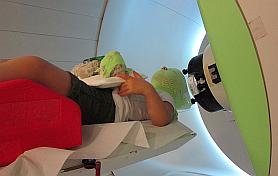
Patients in whom the head area is irradiated receive a so-called mask for this purpose. This is intended to prevent the patient from moving during radiation treatment, causing the irradiation field to shift and subsequently "hitting" healthy tissue rather than the tumour. For making masks for children, usually plastic bandages are used, which are wrapped wet around the head and are thus individually adapted to the patient's head after drying. The mask also has hinges so that you can open and close it quickly.
Important: The mask production does not hurt, but the pads usually get a little warm and sometimes make crackling noises while they dry. Some clinics use plastic masks.
Prior to radiation, the finished mask is attached to the head end of the treatment table (see illustration below). The irradiation field is marked on the mask. Positioning aids on which the radiation field has previously been marked are also used for radiation therapy in other parts of the body.
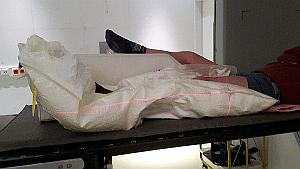
Further positioning aids
Special orthopaedic cushions and plastic stencils are often used. They cushion areas of the body and ensure that the patient's body position is optimally stable during therapy.