General information on paediatric oncology
This page provides general information on paediatric oncology and haematology in German-speaking countries as well as on the German professional society for childhood and adolescent cancers and blood diseases (GPOH).
Author: Prof. Dr. med. U. Creutzig, Editor: Maria Yiallouros, Reviewer: Prof. Dr. med. U. Creutzig, English Translation: Dr. med. Gesche Riabowol (geb. Tallen), Last modification: 2026/02/09 https://kinderkrebsinfo.de/doi/e79946
Table of contents
Frequencies of different cancer diseases diagnosed in Germany
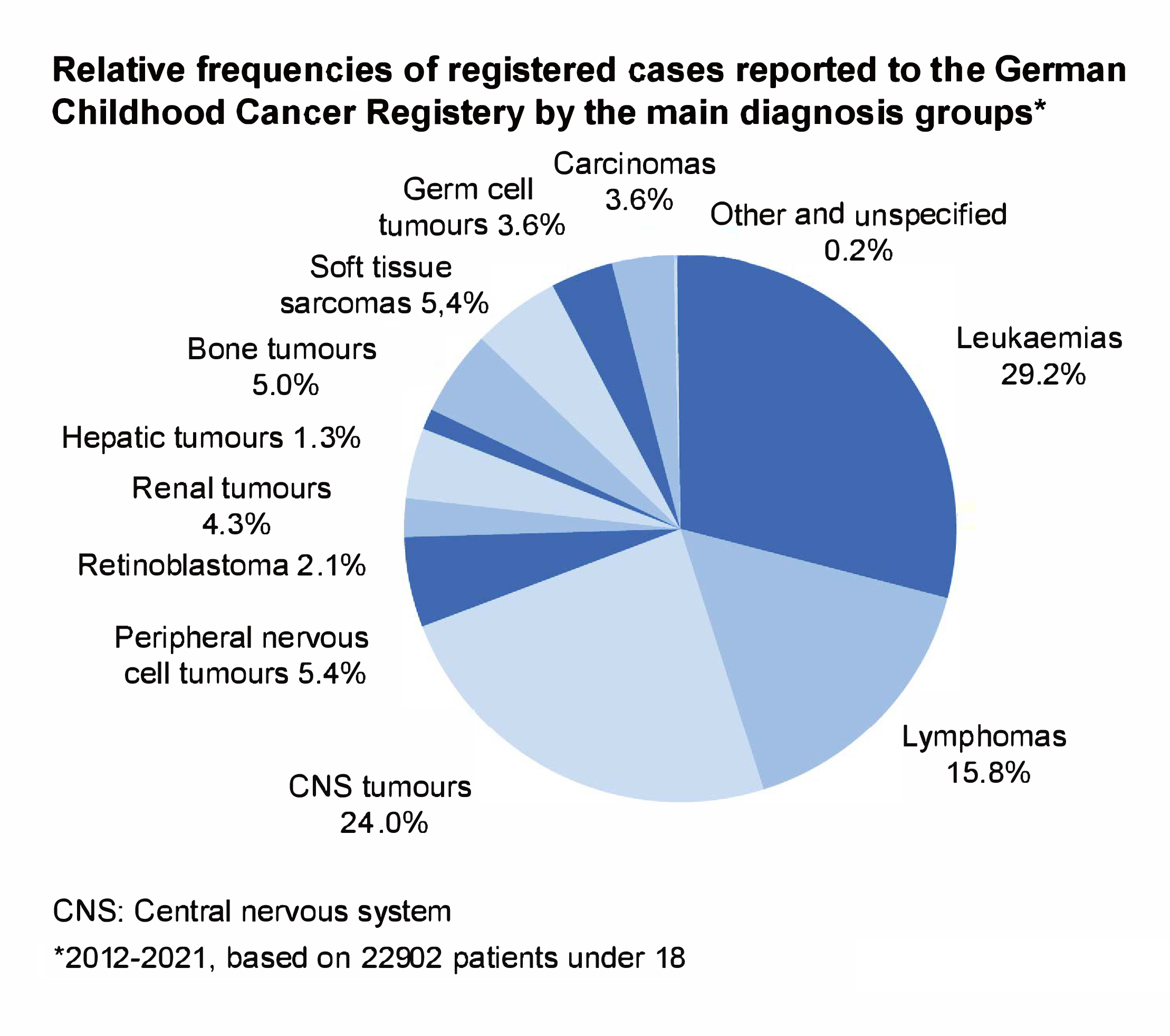
Cancer in children and adolescents accounts for only 1% of all cancer cases in Germany. However, cancer is the most fatal childhood disease and (after accidents) the second most common cause of death in European children after the first year of life. In Germany, there are approximately 2,300 new cases in children and adolescents under the age of 18 per year, with leukaemia, CNS tumours and lymphomas being the most frequent malignant diseases [RON2025].
Development of survival rates among children and adolescents with cancer in Germany
A fatal disease has become curable.
Until the end of the 1960s, the statement ‘Your child has cancer’ was like to a death sentence, as the average survival rate at that time was less than 20%. This unfavourable prognosis has improved significantly over the last 50–60 years. In the last 20 years, great successes have been achieved in the treatment of paediatric malignancies, often in the context of international studies. The 15-year survival rates for all malignant diseases are now around 85% [RON2025]. The therapy has been standardised for many entities and reduced in intensity and thus toxicity. Another groundbreaking development was the discovery and subsequent consideration of minimal residual disease (MRD) in risk assessment, which is now used for almost all entities.
Survival rates between 1940 and 2014
Between 1940 and 2014, survival rates in Germany initially rose sharply, then continued to increase steadily (see figure below).
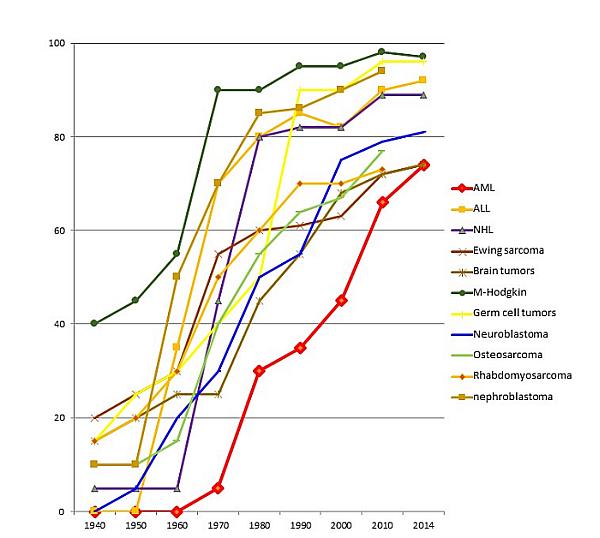
2-year survival rates are shown up to 1980; from 1980 onwards, 5-year survival rates are shown. Source: German Childhood Cancer Registry GCCR, Competence Network Paediatric Oncology and Haematology (KPOH).
Survival rates between 1991 and 2014
Between 1991 and 2016, there was – compared to the earlier period (see above) – only a slow further increase in overall survival rates (OS) in Germany; the only exception to this was acute myeloid leukaemia (AML) (see figure below). For many cancers in children and adolescents, OS of over 80% have been achieved. For unfavourable risk groups, the prognosis is aimed to be further improved. In addition, reducing short- and long-term side effects is now a key objective.
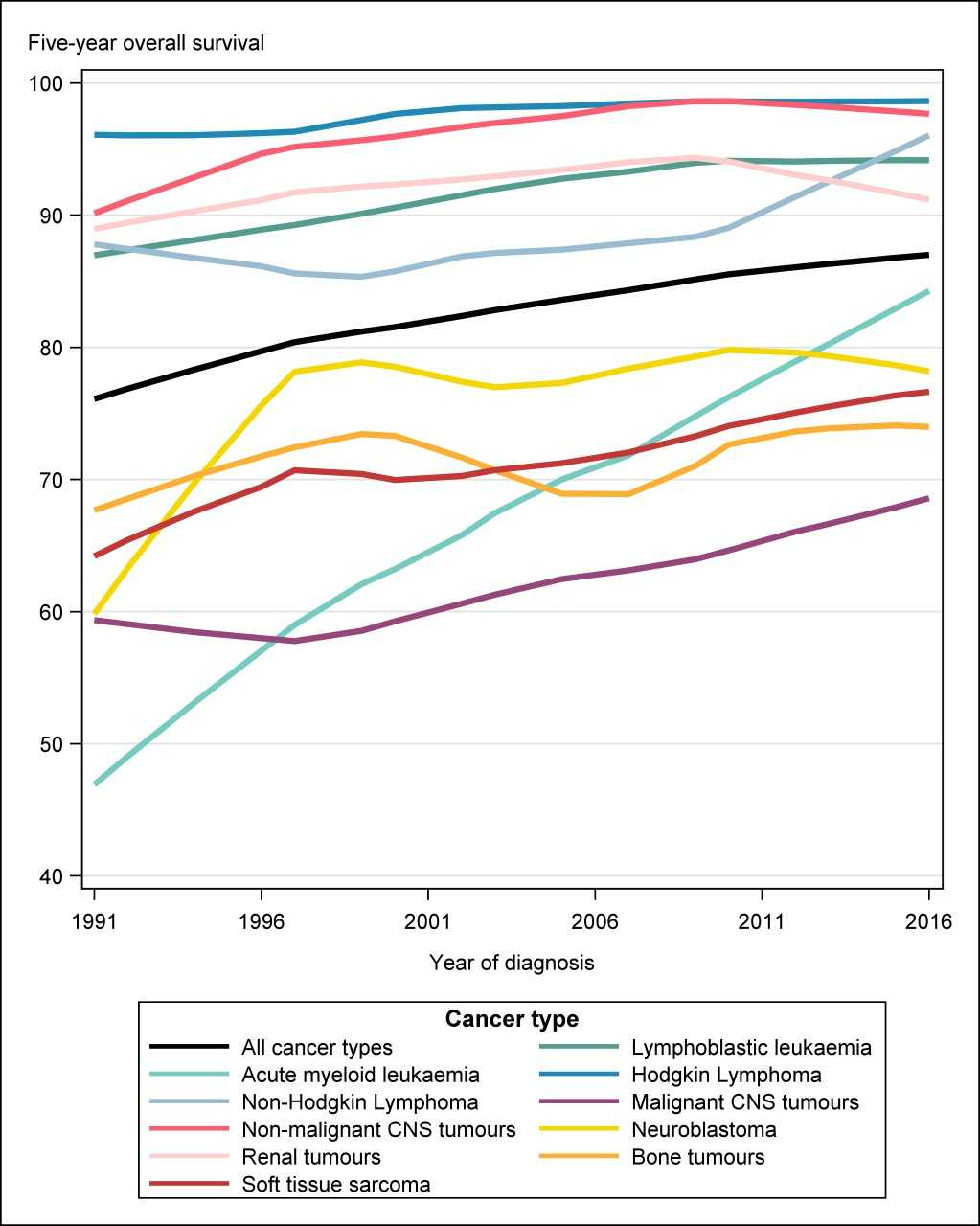
5-year survival rate after cancer in childhood and adolescence (0-14 years) in Germany, 1991-2016 (Source: German Childhood Cancer Registry)
German Society for Paediatric Oncology and Haematology (Gesellschaft für Pädiatrische Onkologie und Hämatologie e. V., GPOH)
In Germany, the German Association for Leukaemia Research (DAL) and the Society for Paediatric Oncology (GPO) joined forces in November 1991 to form the Society for Paediatric Oncology and Haematology e.V. (GPOH). The registered office (e. V.) of the association is Frankfurt am Main. The tasks of the GPOH e.V. are diverse. They include, for example, the treatment of patients under the roof of so-called treatment optimising studies, research of the different diseases, continuous education and training of specialists and medical staff as well as collaborations with other professional associations.
By maintaining progress in basic and clinical research, developing and establishing new therapeutic concepts and drugs, and improving supportive care measures, patients' outcomes have been gradually improved. The decisive factor for this was the association of paediatric oncologists in national and international professional societies and the implementation of multicentre cooperative therapy studies and registries.